Sunday, May 16, 2010

WK2 Response to Elizabeth Bennert - Chapter 6

As Ben Zanders stated on page 80: "Humor can bring us together around our inescapable foibles, confusions, and miscommunications..." He then goes into talking about how humor also prevents us from picking at each other, back stabbing, and attacking each other.

As a teacher I see the need to lighten up in many different ways.
The calculating self, the one Ben says wants to be noticed and appreciated really needs to take a back seat in education. This is not a job full of bonuses and thank yous every day. Many days are spent trying to get students to work, parents to understand, colleagues to listen and doing what you are told by admin. There are not many days where the stand up and notice how awesome I am self gets its acknowledgments. Instead of getting in a temper about it, laugh, sigh and sing some Jimmy Buffett for "if we didn't laugh we would all go insane"

The story about June leaving her husband, only to realize eventually that had she let that guard down, relax and just take the world as it is, she realized that she was part of the problem in her marriage and one she figured that out, things were better for her. I realized that when I was stressing out about things in life and getting all worked up, the people around me (husband, kids, students, co-workers) would feed on that down emotion. I understood that though stuff happens, if you let everything get you down, you will always be down. So I just keep telling myself: it is, what it is, and there is not point festering over it. So laugh and be goofy...it spreads and everyone around you will have a lighter mood as well.

1 comments:

Ashley said...

The infamous Rule Number 6, “don’t take yourself too seriously.” I completely understand where you are coming from Liz. You made it very clear when stating that this is not a job where you get noticed everyday. And if you expect to get noticed, it will get you down. Sometimes it can be overwhelming, and even when I occasionally get that recognition, I don’t even acknowledge it til I get a break and realize what just happened.

I have to say that I am unnerved by those people that act like life is wonderful all the time. It only gets to me because I wish I was like that. Stress gets the best of me, and like you, it affects the people around me that I care about the most, my family. Thank you for sharing your thoughts on this chapter. It’s an eye opener and a relief to know that it’s ok to lighten up.

Friday, May 14, 2010

WK2 Reading - Lighten Up


Well I must comment on Chapter 6 – Rule Number 6. Don’t take yourself so goddamn seriously. I was so happy to read that the topic of the chapter was to lighten up. “When we practice Rule Number 6, we coax this calculating self to lighten up, and by doing so we break its hold on us” p. 81.

When reading about the downward spiral of the calculating self, I couldn’t help seeing myself in that downward scheme to try to better myself only to always end up in the cycle again. To be completely fulfilled is difficult because what I want always changes. My goals change and intensify. It shouldn’t be so hard to just be happy. I think it is natural to blame others for failure as in the case of June and Mark. I usually blame myself for everything though. That has been a difficult pattern to break.

That was an amazing story about the older and younger business partners and the central self. Been thinking about life situations a lot lately. It’s been a rough year. All I can do is smile and know that it is what I make it, so don’t stress. I’ll just keep reminding myself of Rule Number 6.

Reference:

Zander, R. & Zander, B. (2000). The art of possibility: Transforming professional and personal life. Boston, MA: Harvard Business School Press.

Image:

Creative Commons

WK2 Wimba Session 2 - AR Status/Summary and Publishing/Leadership Project

I was unable to attend the Wimba this past Tuesday largely in part because I had so much work to catch up on, there was just no time. My lit review was in shambles and I desperately needed to edit, revise, and email it in. I had a lot of trouble formatting the document in word. The headers were not numbering correctly. It has been very frustrating.

As I watched and listened to the archive, I was relieved to see that I wasn't the only one struggling with the lit review. I do appreciate having a form to fill out checking on what I’m doing. At times I felt alone when working on AR. I need structure or at least know someone is checking up on me. This is helping me get the AR site organized, something I struggle with (organization). So I am feeling much better about the site now.

As for the AR summary page, I don't think it is as daunting now that I have more of a grasp on all the pages of the site.

What I really needed was some clarification on the Publishing/Leadership Project. I'm still a little hesitant on starting a keynote because I'm not sure what to do just yet. That and writing a scripted speech will be a bit difficult. I usually never teach by a scripted speech as was mentioned of most teachers during wimba. Well, first step is figuring out where I want to publish, so that's on the agenda now, publishing on the web.


Web Publishing Image: Creative Commons

Sunday, May 9, 2010

WK1 Project - AR Status


Well EMDT has gone by very fast. I can’t believe there is less than two months before graduation. The one thing that has been foreboding thus far is the Action Research Project. I have been so nervous about putting everything together. It’s all there, just not organized. I lack some very pertinent organizational skills. It’s the art teacher curse, right brain thinkers. Ok, it’s mostly just me. The literature review has taken more time than I anticipated. I originally wanted to explore student motivation with student personal interests. It wasn’t successful due to the middle school age group. It’s an age group that is full of wonder and excitement, yet they don’t know who they are. They are at the exploring phase, finding out what they like and don’t like, what’s cool and not cool. It’s a difficult time for this age group.

That being said, I changed the focus to a regional event art competition that prepares students for high school and the state level art competition. The competition is called the Junior Visual Arts Scholastic Event.

Cycle 1 just gave me a basis as to what their final art piece should be. It wasn’t intended to do so, but I used that information to get them to the place they needed to be by May 1, 2010. Then, by cycle 2, they had an idea of what original art meant. They were prepared for the Junior Visual Arts Scholastic Event by creating original artwork and posting comments on flickr. This made students more conscious of peer to peer feedback for critiques.

The AR Status Report is keeping me in check as I have to get everything organized by tomorrow. The pages on the AR page are placeholders, and it has been a challenge to get it all filled in with detailed analysis. The work is done and I can’t wait til the final presentation!

Image: Creative Commons

WK1 Free Choice - Edutopia Interview

This video from Edutopia is Principal Dereck Pierce talking about Casco Bay High School as a school that builds relationships with it’s students to develop them as people ready for real world experiences. The teachers coincide to build curriculum together though a week of staff development.

Principal Dereck Pierce says his school is curriculum driven by learning expeditions. There are two a year, one in math and science, the other in humanities. The school has exceeded in every area as far as testing is concerned yet this school does not teach to the test. They use real world experience to teach. He also talked about not using text books, instead using laptops,very non-traditional.

I think this is a great view of education today in the world of possibilities. This is a principal who has accepted the change of times and wants more for his staff and students. A leader or administrator that sees this can make a huge difference for the community. I’m not saying a teacher cannot do the same, but getting another authority’s support can really help make that change faster.

Reference:

Edutopia. (Producer). (2010). Principle dereck pierce on building relationships between students and teachers [video]. Retrieved May, 9, 2010 from The George Lucas Educational Foundation. http://www.edutopia.org/maine-project-learning-relationships-derek-pierce-video

WK1 Response to Jill Davis - Free Choice: Reading, Giving

WK 1 – Free Choice: Reading, Giving

Sunday, May 9, 2010

Wow! What a wonderful chapter! And how ironic, I gave the first chapter an A, and the third chapter gave me an A! Now I can work at giving myself an A as well. For me, it is much easier to give others an A than myself an A. This was a powerful chapter for me on a personal level.

In my classroom, I do give each student an A. This only began several years back when I noticed how much one struggling child hated kindergarten. She was my weakest student in regards to working with content. She was always the last one finished and often needed help. I, as well as her peers, regarded her as behind. Our speech therapist reminded me that all students bloom at their own time. No matter how much we fertilize them or water them, they will not bloom until they are ready.

The next year, my lowest content student happened to be really wonderful at art. I made sure to point out to the class his abilities. It was amazing how the class and I regarded him as talented and how it helped him to bloom. By being perceived as an A, he shined as an A.

From that time on, I made it a point to really focus on each individual child's special talents. Like Michelangelo once said, “Inside every block of stone or marble dwells a beautiful stone.” And as Zander found, in the universe of possibility, we can help each child to be viewed as gifted in _____.

Also, in regards to mistakes, I often tell my students we all make mistakes; that is how we learn and grow. But I am most excited to add lifting our arms in the air and saying, “How fascinating!” when we make a mistake.

Sources:

Zandler R., & Zandler B. (2000). The art of possibility. Boston: Harvard Business School Press.

Photo taken by Jill Davis.

Sunday, May 9, 2010

1 Comment

Ashley Burch

Oh give yourself an A already! Jill, you have come so far and you are doing great! I love the picture by the way. It is the cutest, arms up and wide-eyed.

It must be so challenging to teach kinder because each child is at a different developmental level. I wouldn’t know the first thing of what to teach or how to motivate them. You have a tough job and you are a wonderful teacher. I love how you talked about your artistic student and highlighted his talents to the other students. “By being perceived as an A, he shined as an A.” Amazing. I bet he is so proud to have a teacher who sees him for who he is and is proud of that. And yes, it is wonderful to make mistakes!

WK1 Response to Micheline Guerriero - Breaking out of your mold

Wednesday, May 5, 2010

Week1 Reading Response: Breaking out of your mold

The fear of failure blocks the mind and spirit from growing. There is nothing more sincere than when a student looks up at me and says, “I know I didn’t do this right” or “this is horrible.” These are the moments when a simple pleasant response, a helpful tip, or words of encouragement can change a student’s life and outlook towards trial and error. Passion, drive, and originality are fragile qualities that a person possesses.

I love the “give an A policy” One complaint I always had about art school was the subjective grading. There were always rubrics that described the requirements but none factored in the professor’s opinion or hidden expectations. It is hard to place a grade value on something like a painting or performance. While I am sure most teachers would never intentionally grade based on their opinion I think the teacher’s preference for style and technique are always reflected.

Additionally I’d like to share this quote from the book, The art of Possibilities, page 18.

“On our path to achieving a goal we inevitably encounter obstacles. Some of the more familiar ones, aside from other people, are scarcities to time, money, power, love, resources, and inner strength.”

I think this passage speak for itself… Ain’t that the truth

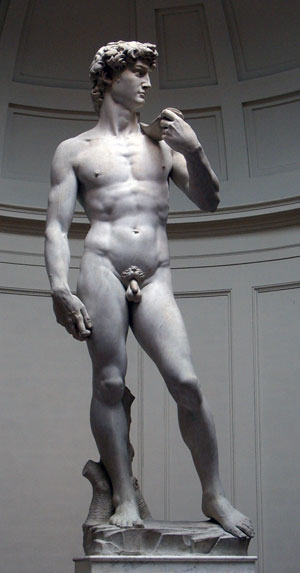
The following video is a close up 3-D examination of the David by Michaelangelo. The video reflect the vision and dreams of Stanford University students as well as the extraordinary talent of the original artist.
Ashley said...

First of all, that was an amazing video on 3D rendering of David. I remember during my study abroad in Italy going to Academia to see the magnificent statue and nothing compared to seeing it up close in real life. The detail in the veins and muscles was incredible.

I do agree that as an art teacher, it is difficult to hear the uninspired words of our students. It is difficult to hear them struggle and think they can’t do anything right. Often, I hear the words. “Is this right..how about now, does it look good now?” They are so concerned with doing it right that they ask about every line, every brush stroke. It’s exhausting for me and them, yet I am subjectively grading them. And now I know the expectation of creating a perfect piece of art is very hard on a student. I do love the giving an A concept. It allows for much more freedom of expression.

Image: Creative Commons